We are pleased to announce that this year we have again supported a student through the successful completion and defense of his diploma thesis. His work addressed the development of model predictive control for residential heat supply:
The heat transition brings a growing share of heat pumps and bivalent supply concepts. At the same time, significant changes in electricity and gas prices can be observed, not least because of current geopolitical events. Time-varying tariffs with peak and off-peak rates are also becoming more relevant to align demand with fluctuating renewable energy supply. Under these changing conditions, rule-based controls make cost-optimal operation more difficult.
The diploma thesis used simulation to test a model predictive control concept for the heating center of the BRExx demonstrator in the ARCHE research project. The plant includes a brine-to-water heat pump, a CHP unit, a condensing boiler, and two stratified storage tanks at high and low temperature levels. A mixed-integer linear plant model, a linear cost function, and predefined price curves can determine cost-optimal operation. Unlike explicitly formulated rule-based controls, all availability constraints and price developments can be incorporated implicitly as constraints and updated at any time.
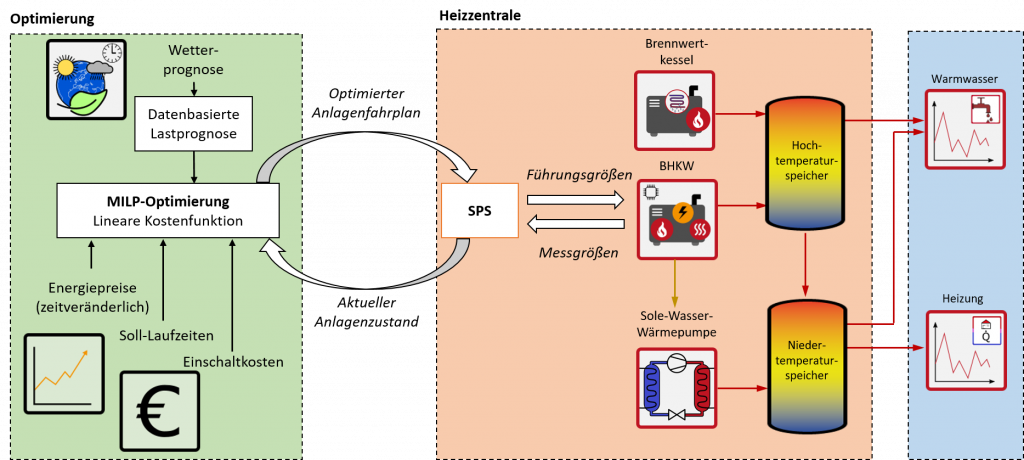
A simulation-based case study covering two winter weeks with off-peak electricity from 10:00 p.m. to 6:00 a.m. showed that predictive dispatch optimization with a perfect load forecast can reduce generator switching by at least 53%, effectively manage load peaks, and use off-peak periods to precharge storage. Assuming a gas price of 6 ct/kWh, parallel operation of the CHP unit and heat pump dominates, as also prescribed by the existing control logic. In a second scenario at 12 ct/kWh, the heat pump runs on grid electricity during off-peak periods, achieving theoretical cost savings of up to 11.52%.
Author: Leonhard Wenzel
EA System Dresden GmbH thanks Prof. Clemens Felsmann and Dr. Peter Stange (TU Dresden, Chair of Building Energy Systems and Heat Supply) for supervising the diploma thesis.